

Big news for GST taxpayers. In a landmark judgment, the Supreme Court of India has…
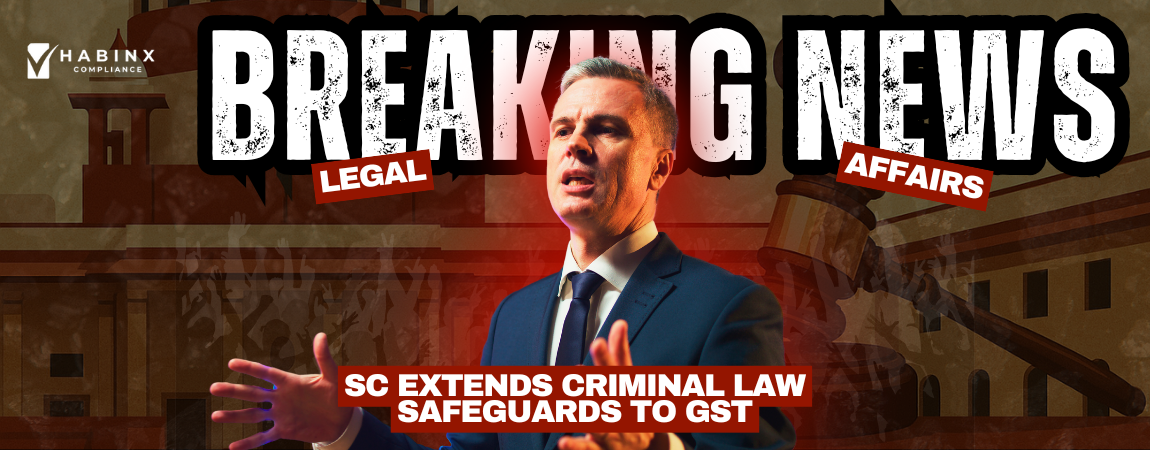
GST, Customs Now Under Criminal Law Safeguards: Supreme Court Strengthens Taxpayer Rights
Tax laws don’t exist in isolation anymore.
In a landmark judgment, the Supreme Court of India has ruled that proceedings under the Goods and Services Tax (GST) Act and the Customs Act must follow the same procedural safeguards as criminal law. This means individuals accused under these laws are now entitled to protections traditionally available to criminal defendants.
The ruling, delivered by a three-judge bench, marks a major shift in how tax enforcement will operate going forward.
Background of the Case
The Supreme Court was hearing a batch of 279 petitions challenging the penal provisions of the GST Act and the Customs Act. Petitioners argued that these provisions were unconstitutional and inconsistent with procedural safeguards laid down under the Code of Criminal Procedure (CrPC) and the Bharatiya Nagarik Suraksha Sanhita (BNSS).
The core concern was simple. Tax authorities had been granted wide powers of investigation, arrest, and prosecution, often without the checks that apply in criminal cases. This, the petitioners argued, opened the door to misuse.
The Court agreed.
Key Ruling by the Supreme Court
The Supreme Court ruled that GST and Customs proceedings with penal consequences must comply with criminal law safeguards. In practical terms, this brings tax enforcement closer to constitutional principles of fairness and due process.
Criminal Law Safeguards Now Applicable to GST and Customs Cases
As per the ruling, individuals accused under GST and Customs laws are now entitled to:
Protection against self-incrimination
No person can be forced to make statements or provide evidence against themselves during investigations.
Right to legal representation
Individuals have the right to consult and be represented by a lawyer during questioning, investigation, and prosecution.
Protection against arbitrary arrest and detention
Arrests must follow due process. Authorities cannot exercise arrest powers mechanically or without sufficient grounds.
Right to a fair and impartial trial
Proceedings must adhere to principles of natural justice, ensuring transparency, fairness, and judicial oversight.
Why This Judgment Matters
What this really means is balance.
Tax enforcement is necessary. Tax harassment is not.
This ruling ensures that while the government retains the power to investigate tax evasion, individuals are protected from excessive or unchecked authority. It reinforces that tax laws with criminal consequences cannot operate outside the framework of constitutional safeguards.
The judgment also brings clarity for businesses, professionals, and individuals who often find themselves caught in prolonged investigations without knowing their rights.
Impact on Taxpayers and Businesses
For taxpayers, this decision offers:
- Greater legal certainty during GST and Customs investigations
- Reduced risk of coercive actions by authorities
- Stronger grounds to challenge unlawful arrest or procedural violations
- Increased importance of proper legal representation during tax disputes
For businesses, especially those involved in imports, exports, or high-value GST transactions, this ruling acts as a protective shield against arbitrary enforcement.
What Should Taxpayers Do Now?
If you or your business is facing investigation under GST or Customs laws:
- Stay informed about your procedural rights
- Do not provide statements without legal advice
- Ensure arrests, if any, follow due process
- Seek professional legal and compliance support at the earliest stage
Proactive compliance and informed decision-making are now more important than ever.
Conclusion
The Supreme Court’s decision is a significant step toward fairness in tax administration. By extending criminal law safeguards to GST and Customs proceedings, the Court has reaffirmed that rule of law applies equally to tax enforcement.
This judgment is expected to influence future guidelines, departmental procedures, and judicial scrutiny in tax-related prosecutions.
At Habinx Compliance, we closely track such developments to help businesses and individuals stay compliant, protected, and informed.
Prepared by: CS Lalit Rajput
Source: As per Supreme Court ruling
Disclaimer: Every effort has been made to avoid errors or omissions in this material. Despite this, errors may occur. Any discrepancy noticed may be brought to our attention and will be addressed in future updates. The author shall not be liable for any direct or indirect damages arising from the use of this information.
Frequently Asked Questions (FAQs)
1. What did the Supreme Court rule regarding GST and Customs laws?
The Supreme Court ruled that individuals accused under the GST Act and the Customs Act are entitled to the same procedural safeguards as those available under criminal law. This includes protections under the Code of Criminal Procedure and BNSS.
2. Does this mean GST and Customs cases are now treated as criminal cases?
Not all GST or Customs matters are criminal. However, cases involving penal provisions, arrest, or prosecution must now follow criminal law safeguards and due process.
3. Can GST or Customs officers still arrest individuals?
Yes, but arrests can no longer be arbitrary. Authorities must follow criminal law procedures and justify arrests based on legal grounds, ensuring protection against unlawful detention.
4. Do taxpayers have the right to remain silent during GST investigations?
Yes. The ruling reinforces the protection against self-incrimination. Individuals cannot be compelled to make statements or provide evidence against themselves during investigations.
5. Is legal representation allowed during GST and Customs investigations?
Yes. Individuals have the right to consult and be represented by legal counsel during investigations and prosecutions under GST and Customs laws.
6. How does this judgment protect businesses and professionals?
The ruling reduces the risk of misuse of authority, ensures fair investigation practices, and provides stronger legal protection for businesses and professionals facing GST or Customs proceedings.
7. Will this ruling affect ongoing GST or Customs cases?
The judgment is expected to influence both ongoing and future proceedings, especially where arrest, detention, or prosecution is involved. Courts may apply these safeguards while examining pending matters.
8. What should a taxpayer do if they receive a GST or Customs notice?
Taxpayers should not panic, avoid giving statements without legal advice, ensure procedural compliance by authorities, and seek professional assistance to protect their rights.
Related Posts


Related Article Posts:
 ROC Filings or Annual Filings of Companies under the Companies Act, 2013
 IT Audit: Making Sure Technology Works for You, Not Against You
 NBFC Compliance – A Complete Guide
 NBFC Ready Reckoner (Part 1)
 NBFC Funding and Takeover Procedure in India: The Complete Detailed Guide (2025 Edition)
 What Is Strategic Management?
 Strategic Analysis & Business Environment: A Complete Guide for Modern Organisations
 Strategic Choice in Strategic Management: A Complete Guide to Types of Strategies, Growth Models, and Portfolio Tools
 Why Do Strategic Implementation and Evaluation Matter?
 Merger and Amalgamation under the Companies Act, 2013
 GST Appeal Relief 2026: Supreme Court Allows ITC for GST Appeal Pre-Deposit
 Tax Regime Switching Explained: Who Can Change and How Often?
 Introduction to GST Return Filing Online in India
 PF UPI Withdrawal Rules 2025: Faster EPF Access, What Members Should Know
 NRI Tax: Gist of Section 115G of the Income Tax Act, 1961
